
The People’s Bread
A Real Bread that serves as a benchmark for wholesome change in the way we grow, mill, bake and eat grain.

It’s not hard to identify what’s wrong with industrial bread – its ‘low price’ and ‘convenience’ are a poor justification for the environmental damage done by the way chemically-farmed grain is grown and the havoc wrought on bodies by ultra-processed, fast-fermented, additive-laced dough.
At Scotland The Bread we strongly believe that in a just society, nutritious, tasty and digestible bread should be easily available to everyone, as of right. ‘The People’s Bread’ is our proposal – a template for creating delicious healthy bread, guaranteed to benefit both people and planet, made available and accessible to all.
Funding from the Rural Fife Development Fund allowed us to develop this concept and explore methods for increasing its impact and reach:
- Based on extensive research we have drawn up a set of standards which – when followed – will produce bread that positively impacts personal and planetary health.
- Consultation with engaged community bakers helped us create materials to support more people in baking The People’s Bread with and for each other.
- A ‘train the trainer’ workshop format is designed to pass on information and skills to community chefs and organisers, for sharing in turn with people in their area.
Recognising that no-one can engage a community better than its own members, we hope that this model will result in more people learning about, tasting and creating their own People’s Bread!
In 2023 we ran a ‘train the trainer’ workshop with a group of community leaders from across Fife. By the end of the day all expressed confidence and enthusiasm for sharing breadmaking knowledge and skills as a result of the session, with ideas as varied as:
– Organising adult learning classes encouraging people to bake at home
– A community bread club which shares information on the bread system as well as breadmaking skills
– Baking for community meals and / or a community larder
– Running demonstrations then encouraging people to join in
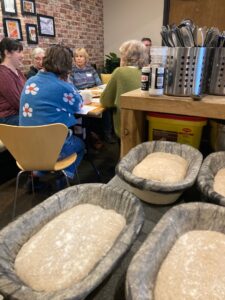
Participants expressed that many of their community members are living with food and fuel insecurity and that they see breadmaking as an activity that would complement current efforts to tackle these issues. Connections made between workshop participants appeared equally valuable as several are local to each other and can provide peer-to-peer support.
“I absolutely loved the workshop. It was fantastic to be part of a group who are all so enthusiastic about bringing bread-making skills back to the community.”
The basic criteria for ‘The People’s Bread’ are set out below.
Adaptability is a key part of the concept, which is why we are promoting guiding principles rather than a particular recipe. Our vision is to see these realised in breads of all shapes and sizes, reflecting the taste, culture and collaborative energy of the people that make and enjoy it.
______________________________________
The People’s Bread = a well-fermented bread, made with a high proportion of organic Scottish-grown and -milled grain, aimed at producing a nutritious, affordable and accessible bread for everybody.
1. Flour
At least 75% of the flour must be wholemeal, milled in Scotland from organic Scottish-grown grain (wheat, rye, barley, oats etc). Up to 25% of the flour can be lighter than wholemeal, but must also be milled in Scotland from Scottish-grown organic grain.
2. Other ingredients
Salt (at less than 1% of dough weight), water, baker’s yeast (not fast-acting which usually has additives in it), and sourdough starter (itself only organic flour and water) should be the only other ingredients.
3. Method
There is abundant evidence that natural fermentation using a simple starter culture of flour and water (the method usually known as ‘sourdough’) allows the activation of beneficial microorganisms in the dough that create the healthiest, most digestible and tastiest bread.
If bought-in yeast is used, it must not be ‘instant’ or ‘fast-acting’ and must be used at less than 1% of the total dough weight. The dough should be fermented for a minimum of four hours. A common (traditional) way of achieving this is to use a small amount of yeast to make a ‘sponge’ (using a quarter to a third of the total flour and water) which is fermented overnight (for about 16 hours) before being combined with the rest of the water, flour and salt.
4. Affordability/accessibility
The aim of the People’s Bread is to be available to everyone as of right.
For home bakers, this might mean a commitment to ‘bake two, share one’.
For community food hubs using a ‘community subsidy’ such as Scotland The Bread’s solidarity bag might do the trick.
For commercial bakers, ‘pay what you can’ or ‘pay forward’ schemes could help ensure that the best is available to everyone, irrespective of resources.
______________________________________
Get involved
- Share your version of ‘The People’s Bread’! We are appealing to the collective creativity of professional, community and home bakers to translate these criteria into daily breads of all shapes. We hope to share as many ideas and approaches as possible to bring better bread within even more people’s reach, so would love to hear about yours! Please send your recipes and stories to hannah.ewan@scotlandthebread.org
- Take inspiration from the People’s Breads made by others, which can be found on our ‘Recipes’ page.
- Take a look at our resources page for an interactive toolkit, information sheets and posters explaining more about the current bread system and how to create a better alternative: