

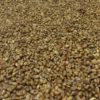
Evolutionary organic rye grain (for home milling and cooking)
Key information
- Variety name: Evo
- Certified organic rye grain
- Evolutionary spring rye developed by Hans Larsson in Sweden, grown at Balcaskie since 2021 (currently milling crop 2023)
- Above-average values for most key minerals
- Suitable for home milling to make real bread (with long fermentation and no additives), moist fruit cakes and North European spice biscuits
- Also suitable for cooking as rye ‘berries’
More Information
‘Evolutionary’ means that there is a high degree of genetic diversity in the crop (unlike in modern ‘monoclonal’ wheat varieties where every plant in a field is identical to the others). This diversity is a key part of the radical agro-ecological transformation of our food system that is needed to steer our farming and food towards net zero climate heating emissions in line with national commitments to deal with the climate emergency.
A field of grain in which every plant is identical is highly vulnerable to ‘shocks’ from pests, diseases or seasonal weather events. Diversity means that at least some of the plants will survive, crucially without the use of pesticides and fungicides. Our Evo rye has been grown on from Hans Larsson’s evolutionary Fulltofta rye, composed of varieties and mixtures sourced from many places and then grown together over successive seasons. Careful selection and evaluation of the best grains ensure that the crop improves without sacrificing diversity. Transplanted into Fife soil, this rye is gradually adapting to the local soils and micro-climate. The crop that is growing in 2025 will be re-named (with Hans Larsson’s blessing) ‘Balcaskie Evolutionary Rye’.
Top tips for milling and baking with this grain:
- Keep the grain dry. Around 15% moisture is best. We send it out at about 13%, but it can absorb moisture from the atmosphere, especially in rainy or humid weather. If you don’t have a moisture meter, you’ll have to judge by the hardness of the grains when you bite one. If it’s soft and easy to bite through, the grain is probably too moist. You’ll know if you are trying to mill grain that’s too moist because it will clog up the stones and cause them and the motor (or your brow) to get very hot. Grain can be dried, spread out on a baking tray and turned regularly, in a very low oven – anything higher than about 50°C will begin to damage important yeasts and enzymes and may affect the gluten quality of the flour
- Always ferment your bread slowly (using sourdough) to control dough development, bring out flavour and enhance digestibility and nutrient bioaccessibility
- If you’re struggling to get a longed-for lightness, sieve the flour to remove some of the bran or add a portion (up to 25%) of ‘strong’ flour
You will find more baking advice and recipes here.
Apart from its above-average mineral content, this grain has some other qualities that bakers should note:
- Though relatively low in protein (9.86%) and with a surprisingly low Falling Number (91), this rye can be turned into wonderful bread by bakers with a basic understanding of fermentation. It is no accident that the great rye bread baking traditions of Eastern and Northern Europe depend on long fermentation with sourdough. Indeed, without sourdough, this flour will make an extremely sticky dough and bread. The reason is that sourdough lactic acid bacteria take time to acidify the dough in a way that controls excessive conversion of starch to sugar by the amylase that is naturally present in cereal grains. Low Falling Numbers equate to higher amylase levels, and by industry standards 91 is low indeed. But the pay-off is that this flour is naturally rich in maltose sugar which accounts for the lively fermentation that sourdough bakers have reported when baking with it.
- It follows that best results will be obtained with a longer, cooler fermentation in which the sourdough lactic acid bacteria have sufficient time to acidify the dough. It can help to reduce the proportion of ‘production sourdough’ (see Andrew Whitley’s helpful DO Sourdough book for an explanation of this term) in your final dough so that the final rise (‘proof’) takes longer, allowing time for the all-important acidity to infuse the entire dough.
You will find more baking advice and recipes here.
| Weight | 3.1 kg |
|---|---|
| Bag size | 3 kg bag, 16 kg bag |
Related products

Scottish Flour and Grain
Price range: £7.50 through £30.00
Scottish Flour and Grain
Price range: £4.50 through £36.00

Scottish Flour and Grain
Price range: £4.50 through £36.00