

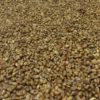
Balcaskie Landrace organic wheat grain (for home milling or cooking)
Key information
- Variety name: Balcaskie Spring Landrace
- Certified organic wheat grain; crop 2023
- A diverse mixture of evolutionary grain varieties, mostly from Scandinavia, grown together in Fife since 2021
- Above-average values for most key minerals
- Suitable for home milling to make real bread (with long fermentation and no additives) and pastries, cakes and biscuits
- Suitable for cooking as wheat berries
More Information
Balcaskie Spring Landrace wheat was created in 2021 by mixing Swedish, Danish and British spring wheats, chosen for their diverse genetics, and then re-sowing the harvested seed each year. The aim is to harness the adaptive power of natural selection to a particular landscape – in our case, the coastal East Neuk of Fife in Scotland.
Top tips for milling and baking with this grain:
- Keep the grain dry. Around 15% moisture is best. We send it out at about 13%, but it can absorb moisture from the atmosphere, especially in rainy or humid weather. If you don’t have a moisture meter, you’ll have to judge by the hardness of the grains when you bite one. If it’s soft and easy to bite through, the grain is probably too moist. You’ll know if you are trying to mill grain that’s too moist because it will clog up the stones and cause them and the motor (or your brow) to get very hot. Grain can be dried, spread out on a baking tray and turned regularly, in a very low oven – anything higher than about 50°C will begin to damage important yeasts and enzymes and may affect the gluten quality of the flour
- Always ferment your bread slowly (using sourdough) to control dough development, bring out flavour and enhance digestibility and nutrient bioaccessibility
- If you’re struggling to get a longed-for lightness, sieve the flour to remove some of the bran or add a portion (up to 25%) of ‘strong’ flour. We recommend Mungoswells organic flour from East Lothian.
You will find more baking advice and recipes here.
This grain is special. Apart from its above-average mineral content, this grain has some other special qualities:
- It has a full, slightly malty flavour which comes in part from typical harvest conditions in the Scottish climate. When grain is ripe and gets wet in the ear, the naturally occurring amylase enzyme begins to turn starch into maltose sugar. This is what happens when grain is ‘sprouted’ for making into malt for brewing. Maltose in the flour will, like any sugar, make the dough slightly sticky to the touch. This isn’t a problem if you knead your dough with wet hands. And one of the many advantages of genuine sourdough fermentation is that this process makes the dough acid enough to stop the excessive amylase from going crazy at the baking stage. If the loaf sides seem to shrink in after baking or if your knife comes out sticky however well you’ve baked the loaf, you may not have fermented your dough long enough to neutralise the effects of the amylase turning flour starch into maltose sugar. This can be disappointing until you savour the natural maltiness of your bread and reflect that you achieved this without adding any expensive specialist malt flour
- It contains gluten that is naturally softer, less elastic and more extensible (and arguably more digestible) than in common breadmaking flours. In this respect it is reflecting its evolution as a grain adapted both to the temperate Scottish climate and to the various needs of ordinary bakers. While this grain may not produce super-aerated dough, it comes into its own when extensibility is required in flatter loaf shapes such as ciabatta, focaccia, naan, pancakes etc. If scones and shortcrust pastry are in your repertoire you may be pleasantly surprised that baking with this flour avoids a certain ‘rubberiness’ that tends to be a by-product of using high-gluten or ‘strong’ flours
- Dough made with slightly malty flour (as with additions of honey, sugar or significant levels of fat etc) takes more colour when baking, so it is advisable to reduce your normal oven temperature a little to avoid excessive caramelisation (or ‘burning’ as it is sometimes known). Try 200°C for ten minutes, reducing to 180°C for the remainder of baking.
You will find more baking advice and recipes here.
| Weight | 1.5 kg |
|---|---|
| Bag size | 1.5 kg bag, 3 kg bag, 16 kg bag |
Related products

Scottish Flour and Grain
Price range: £7.50 through £30.00
Scottish Flour and Grain
Price range: £4.50 through £36.00